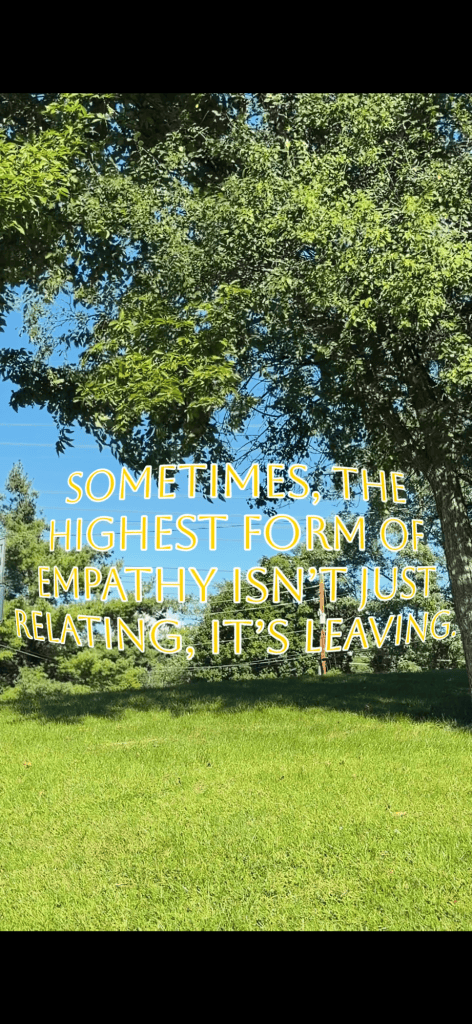
I know, I know.
“Huh!? How can you leave if you love them?”
Usually asked as if leaving someone you love is somehow a crime.
This is a lesson many of us sensitive souls learn the hard way.
When we look at empathy through a one-dimensional lens, we see people circling around and staying put to absorb another person’s emotional storm. It can look like the truest form of devotion, but over time, it can become self-abandonment.
Sometimes, it’s even weaponized as emotional blackmail, precisely because society conditions us to view love as endurance, and empathy as a blank check.
But there is a brutal kindness in walking away. One that isn’t always as obvious as the voice telling you to stay.
When we choose to stay and constantly hold space for someone who refuses to change, or who relies on us to continually bridge the gap, we can inadvertently rob them of the consequences necessary for their own growth.
I argue that the deepest empathy isn’t always about sinking into the quicksand with someone. Sometimes, it’s knowing when to step onto solid ground.
You can’t save someone if you’re sinking with them.
Really, you can’t save anyone anyway. They have to want to save themselves.
But sometimes, stepping onto solid ground is what makes it possible for them to see that they need to find their own way out.
You have to be the change you want to see in the world.
Maybe that’s where discernment comes in.
Discernment tells you when the investment is no longer worth making. But empathy? Deep, painful empathy looks at the quicksand, looks toward the horizon, then back at the other person—and steps onto solid ground so that forward progress finally has a chance to begin.


Leave a Reply